Showing posts with label pain. Show all posts

Monday, 20 May 2024

Uptodatedly

Ven, nino que estas ahí. Vuelve a casa
Madres - Sofia Kortesis

Over dinner last week I said to a friend that we could skip the discussion of my current and recent myeloma:
“It’s ok Alex - you can tell me anything”
“But I don’t really want to talk about it, myself”
… Bearing that in mind … It’s been three months since last dialm, so here’s the skinny …

The chemo is working both biochemically and side-effects-ly. Five cycles in, my light chains are normal and I feel far better tolerating pomalidomide and isatuximab than I did on elranatamab. So that’s all good. Not enough to reassure my consultant, who is concerned about evidence in PET scans of my pelvis. So we’re on watch and wait. He was hinting at changing my chemo, which you won’t be surprised to know I was not much in favour of while it appears to be working, and not too rough. Our compromise was I get another six weeks as we are, and then another PET to help us make the right decision.

Myeloma has always been cyclical - bad periods and good ones. The last two years has much accelerated the frequency of those transitions. Going from good to bad is usually progressive - unless I really hurt myself, in which case it can be very quick. The transition from bad to good comes, at its best, as a sudden release. In my imagining it’s the moment the cumulative load of pain and fatigue drops low enough to release some quantum of mental capacity. The capacity to give a shit. Despite having had better periods among the carnage of the last two years, I haven’t had one of those release moments… I have felt periodically better, but haven’t really felt good. This last week feels very much like one of those moments.

I’ve long observed the impact of my physical health on my mental health, but mostly with an aspiration to decouple them. To not have myeloma of the mind. But, I’m reevaluating that. I don’t think decoupling is practically achievable, and wishing for it is of itself stressful. Maybe better I just embrace the truth: when I’m ill, it’s not much fun, and I’m not usually at my best. Doesn’t sound unreasonable, written down like that. I’m not saying I’ll reduce my bad-times ambition to mere survival, just give myself more license to muddle through as best I can. The last few months have been hard.
“Bare long, I can’t lie”, as my teenagers would put it.

After years of experience I embrace the moment I regain the capacity for living: to sit around the kitchen table chatting with the kids; to potter around the house vaguely contributing to its running; to open my “To Do” list and actually do something; to go out. In theory, even totally immobile, I could prop my laptop on the bed and do the Community Centre accounts, or write poems. In practice… at those times, I just don’t effing feel like it. It’s nice, therefore, to be out of bed again, and to feel like it, again. Not limited by fatigue, or (excessively) encumbered with pain. I’ve many times borrowed the language of mental illness to describe my myeloma experience as making me feel, in a way, bipolar. (Excuse me if that word means more to you than to me and my use of it seems crass. I hate it when people use “cancer” as a metaphor.) When I’m physically ill, unsurprisingly, my mood is low. When I’m feeling better, my mood swings up, abruptly and I feel imbued with power and energy and an urge to get stuff done. Relapse and remission, those are my poles.

This last week I went to a party on Wednesday, went to two exhibitions on Thursday, had people for dinner on Friday, went to someone else’s for dinner on Saturday, and shouted on the touchline of two football games on Sunday (and ate through one piece of chocolate cake, one ice-cream cone, one pickle, one slice of Swiss cheese, one slice of salami, one lollipop, one piece of cherry pie, one sausage, one cupcake and one slice of watermelon). That’s a kind of “normal” that is so often, and for so long, out of reach for me.

It’s irritating therefore that I’ve still been restricted to using crutches or wheelchair because of an injury in my groin. Irritating to feel the “good” period being impeded. I’m hoping it is a mechanical injury, and finally on the mend. If I can just get my consultant to agree that it’s not a cue to change treatment... But it is a lot better than it was. So hopefully this particular storyline is drawing to an end.

I used to plan for the good periods, post SCT: change my job and build a new routine. Now the transitions are so frequent and sudden, I haven’t time for the planning bit. It’s just a matter of chucking myself into things as I feel like it and not worrying about tomorrow. Look out, baby, here I come.

That’s where I am today. By the time we speak I could easily be in a different place. Anything could happen. Something or other most likely will.

---

POSTSCRIPT 21st May

I should really know better than to google my illness, and I'm pretty good at keeping away from it these days. But every now and then.
Anyway, found this - https://pubmed.ncbi.nlm.nih.gov/9172858/  -  Fucking hell

Saturday, 2 November 2019

Recuperation

We've got to hold on to what we've got
Living on a prayer - Bon Jovi *

Day +50ish

It's been a while since I sat at my desk. I have decided that, as of this week, some element of normality must return. So I've turned on the pc, and just waded through several months of unopened email. Nearly 1,000 messages. (Why does junk mail come in waves? A lot of spam about nail fungus.) So, while I'm here, an update for you.

I'm doing ok. I'm very bored, but that's a minor complaint really. My blood counts are alright - could do with a bit more red in my blood; hopefully that will come with time. But I've avoided any nasty infections (so far). And I'm regaining strength, though it comes slowly. Overall, I think my recovery has been easier this time than last, which is a pleasant surprise. Will be nice when my hair starts growing again, and I'm looking forward to having some actual energy.

My relationship with this blog is a bit conflicted at the moment. I know it serves a purpose, but I prefer, mostly, to face the other way. I have a stash of topics that, at some point, I will write up. On the transplant process. On medicine that makes you feel ill. On pain. On mortality. I'm not sure when I'll feel sufficient enthusiasm to commit these to binary. For many of you, though, who only check in here to see how I'm doing... don't expect too frequent updates. I'm 50 days in to a 100 day recovery programme. I've no evidence yet of how well (if!) it has all worked. I'm intending to progressively return to "normal", and see how it goes.

---

One ongoing issue worth a mention, is my poor old back. I'm posting a recent MRI image of my spine. You can see just how many of my vertebrae are crushed, and how curved it is as a consequence. It has definitely got worse, these last 2 years, which is a little scary. What will happen next time I relapse? I've been told that I should expect that the damage is progressive - i.e. it will continue to deteriorate. I find this quite difficult to face up to (I find the picture hard to look at). No matter what treatment I endure and what remission I achieve, I'm left with this creeping disability. Even if they "cured" me, I'd live forever with this. I've recently been in front of the neurologist and an orthotics doctor. We discussed every possibility - from surgery to doing nothing. There aren't any great answers. Surgery really isn't a credible option: it's quite likely that, were we to fix part of my back up (by injecting cement to rebuild vertebrae, or by adding some metalwork), all that would happen is it would fail (break) at the weakest point. I'd be worse off after that. I am fearful enough of ending up in a wheelchair, without doing something that might accelerate the problem.

But otherwise, I'm on to a loser. My back lacks the strength to hold itself upright, and even a small amount of curve means the weight of my head (heads are quite heavy) is pulling the whole thing forward. It was comforting to hear the doctor acknowledge what I already know: that standing still is worse than walking; that I need to spend quite a lot of time lying flat on my back if I want to maintain any kind of posture; that it's unlikely my back will ever be free from pain. Our plan for now is that I am to be fitted with a brace, and see if/ how that might help. The risk is that using a brace leads to loss of muscle tone, making me increasingly dependent on wearing it. But I'm hoping if I moderate how often I put it on, I might be able to mitigate that. It's got to be worth a try.

I didn't understand, when I got my myeloma diagnosis, that disability was part of the prognosis. But I know now that similar problems affect lots of people with mm. It really is a bastard.

---

* This choice of lyric is somewhat deceptive. The song came in to my head for the more obvious reason that 50 is ½ of 100.(Woah, we're half way there!) I'm pretty sure I used the same bit of Bon Jovi, 15 years ago, when writing about crossing the equator, while travelling overland (mostly by bus) from Antarctica to the Arctic. If you're paying that much attention, I salute you. I liked Bon Jovi when I was a teenager, but only really because I liked a girl who liked Bon Jovi. (She'll probably read this.)

I like a bit of lateral-ness in music trivia. If anyone ever asked me to write trivia quiz questions (if they've any sense they won't), then one of them would be the names of songs that do not feature on the eponymous album. Some classic examples are "Houses of the Holy" by Led Zeppelin (song ended off on the subsequent album, Physical Graffiti), "Waiting for the Sun" by The Doors (ended off 2 albums later, on Morrison Hotel) and "Sheer Heart Attack" by Queen (3 albums later, on News of the World). There's a few good examples from 90s indie: "Bring it On" by Gomez  was on their 2nd album, Liquid Skin. Meanwhile "His'n'Hers" by Pulp, "Screamadelica" by Primal Scream, and "Going Blank Again" by Ride, were all only released on EPs or as b-sides.  Are you with me? Too obscure? If you know any more, show off in the comments!

Thursday, 1 March 2018

Thal

Here he comes, he's all dressed in black. PR shoes [*] and a big straw hat. He's never early, he's always late. First thing you learn is that you always gotta wait. I'm waiting for my man
Waiting for my man - Lou Reed

End of Cycle 1 ... Neutros = 1.4 ... Hb = 9.8 ... (KFLC tbc)

<short(ish)>

Those who've seen me around - probably walking a bit unsteadily, certainly wincing - will know my last couple of weeks have not been good. This is in part due to back pain and bone pain. I'm not certain what has caused it all to get worse: whether it is my myeloma progressing; or whether I've aggravated it; or whether it is my body becoming resistant to the painkillers; or whether it is the adjustment/accommodation into the start of treatment. Whatever the cause, it hasn't been much fun. On top of this, I'm feeling even more out of breath than before.

(Plus, I have the ups and downs of steroids to contend with. But more on that another time.)

In summary, not great. I have been reminded - as if I needed it - quite how grim myeloma can be. Though it could, of course, all be a lot worse. And I'm optimistic that the worst of the bone pain is coming back under control. Hopefully the next few weeks will be less arduous than the last.

When I arrive to get my new prescription, the doctors take it all quite seriously. My anaemia is becoming a real concern, but there's nothing to suggest the drugs are making it dramatically worse, so no reason not to continue the treatment. We won't have any meaningful feedback on whether the drugs are working, for another month (they took a blood sample today, but it takes a week to get the result, and anyway, one result on its own won't tell us much). So, we continue on the current course.

They suggest to substantially increase the doses of my painkillers. Hopefully I can return to some quality of life that is a little more bearable. Living "in" it, one sometimes lacks the perspective to see what's going on. It is only when the docs ask me the clinical questions - what is the pain like, how has it changed over time - that I appreciate that living as I have done of late is not OK. It's not just part of the process. It's not my lot in life. It's not just something I have to put up with. It's not just something I have to keep quiet about. Actually, I have a right to expect better, to demand better. Better, in the immediate sense, meaning stronger drugs!

One cycle down, 3 or 5 to go.

</short(ish)>

<long(er)>

A little about the second drug in my treatment triad: thalidomide, of which I currently take 100mg each day. I'm intrigued to be taking thalidomide, because its name is so arresting, so shocking. There isn't a medicine on the planet with a worse reputation. Originally marketed as an anti- morning sickness medication in the late 1950s, thalidomide did appalling damage to the unborn children of unsuspecting mothers-to-be, before being taken off the market again in 1961. Having failed patients so badly in the past, the medical profession is understandably making a significant effort to avoid any more unborn children being exposed to thalidomide. This basically means ensuring those of us taking it don't procreate. I'm not aware of any evidence that thalidomide can affect a baby from its father, but no-one should even want to let that risk exist.

My supply comes in rather glamorous packaging - practically gift wrapped - and with extensive instructions and warnings. The hospital checks up on me too, by asking all sorts of very personal questions. If I were female, they would insist on regular pregnancy tests. I can be grateful of being spared that intrusive indignity. Frankly, it is all a little unnecessary: having managed to have only the children I wanted to, these last 30 years, I have no intention of letting my guard down now.

The thalidomide crisis/scandal served to demonstrate the necessity for proper clinical trials, and to show the need for proper processes to manage and monitor drugs. It is also a striking example of the pharmaceutical industry failing to live up to its responsibilities. It is an important story, but it is not my story.

The reason thalidomide proved so devastatingly dangerous was, ultimately, the reason it was considered as a possible cancer treatment. The deformities in unborn children were caused, we know now, by Thalidomide impeding blood vessel formation. But it wasn't until the mid 90s that this property (called "antiangiogenesis"), was recognised and considered as a possible cancer treatment. Surprisingly, it turned out to be most effective in blood cancer - a cancer where one would intuitively imagine blood vessel formation is not a factor. (Do myeloma tumours have blood vessels?) The pharmacology is complex, and the effects of thalidomide are still not entirely explained. It does a number of things, but we don't really know which of them gives it the anti-myeloma properties. As well as stopping new blood vessels from developing, it is known to inhibit the development of the cells in the body tasked with breaking down old bone ("antiosteoclastogenesis" - just rolls off the tongue!). One of the symptoms of myeloma - the biggest single problem, for me - is that it alters the balance between bone destroying and bone building cells, so that bone is destroyed more quickly than it is replaced. Thalidomide appears to act in the opposite way, but it is not clear whether this helps to explain why thalidomide kills myeloma cells. Maybe it is just a bi-product of interfering in the same processes.

Thalidomide and the other drugs that have more recently been developed in the same family (lenalidomide and pomalidomide, which are presumably working on the same pathways), are not completely understood. We know they work, but not exactly how. You'd be surprised how common that is in medicine. This group of drugs are classed as "immunomodulatory", but given that they are used to treat myeloma, a disease of the immune system, the classification really doesn't tell you much!

Thalidomide is often part of people's very first ("front line") treatment. When myeloma relapses, it is normal to move on to different drugs; the general premise being that the disease is likely to become resistant to drugs it has been exposed to before. As it happens, I didn't take it last time round (because it wasn't part of the trial protocol I participated in). If it weren't taking it now (this time round it is part of my trial protocol), then I think it is quite likely I would have ended off missing it out altogether. That it could easily not have featured in my treatment at all, I find remarkable, considering that less than 20 years ago it was the very first available alternative to old school chemo. That shows how quickly the treatment options have changed and are changing. It is quite likely that I will take its siblings - particularly lenalidomide which seems to have the best combination of effectiveness and fewer side effects - at some point later in my journey.

The side effects of thalidomide are basically that it can suppress bone marrow function. So it can cause or exacerbate neutropenia (weakened immune system) and anaemia. Given that these are problems I already have, there's a risk that things get worse before they get better. That's how it feels right now, with me puffing at even the slightest exertion. Still, I haven't been struck down with any infection (yet) and for that I must be grateful.

</long(er)>

(* PR shoes = Puerto Rican, i.e. "Fence Climbers". Not, as those of us in the trade might incorrectly surmise, Public Relations shoes. Though in spivviness at least, if not in practical law evasion features, the difference isn't necessarily great.)

Friday, 16 February 2018

Ixa

We are the boys who'll drape you in jewels, cut off your hair and throw out your shoes, ‘cause baby, you won't need them, where you'll be
All the king’s men - Wild Beasts *

I figure some of you reading this do not want or need long essays from me. If you’re following simply to know I am ok,  I'm grateful - thanks for caring. For you, a short read...

<short>

Cycle 1 is going ok. The lack of side effects, combined with the simplicity of taking pills, rather than intravenous drips, injections, picc line etc, is leading to something of a reverse placebo effect. The drugs had better work, because I find it hard to believe in them, having been conditioned to old school chemo. It’s a bit disconcerting to find myself taking what appears to be medicine.

That said, the steroids are not very nice - making a mess of my Thursdays and Fridays. But more about that another day. And I’ve been having quite a bit of trouble with pain and spasms in my lower back. My mobility is rubbish, and it hurts a lot. Very frustrating. Still, I'm optimistic the pain will be quelled after a couple of cycles, and if the next few months is like this, it’s not so bad.

</short>

<long>

Still reading? How nice! Even so, I guess you don’t want or need a blow by blow of my days and weeks. Instead, I thought it might be of interest to give a bit of a summary of the drugs I’m on, seeing as I’m in a drug-taking phase of my myeloma. I’m going to start from the top, with the ixazomib. I take one 4mg pill of ixazomib each week, 3 weeks on 1 week off. And if I am selected in the clinical trial to receive "augmented" or "maintenance" treatment, it will be with ixazomib.

Ixazomib is a proteasome inhibitor, which means it disrupts the cell's mechanism for breaking down unwanted proteins. Without functional proteasomes, a cell chokes on its own waste, and dies. All cells need proteasomes, but myeloma cells need them more, as they produce excess quantities of paraproteins. So proteasome inhibitors are particularly bad news for myeloma cells.

The first proteasome inhibitor developed was bortezomib. I took this last time. It was only developed from 2003 so it’s a very new branch of medicine. Before it came on the scene, myeloma had very short life expectancy, and the main drugs prescribed were unsophisticated, generic “chemo”. Proteasome inhibitors are the reason I’m still here.

Ixazomib is even newer - it was only registered as a potential treatment in 2011. When I was newly diagnosed (2012) I kept a list of innovative treatments when I heard about them - part of my armoury towards becoming an engaged patient. (I’ve stopped keeping this list because it got too long - I realised that merely knowing the names of possible medicines was not what would empower me.) At the time I wrote of ixazomib simply
“Ixazomib (MLN9708) (can be taken orally) FDA approval projected 2015."
In fact, approval came a little later, in 2017 in Europe. NICE only consented for the NHS to pay for it as of November - 3 months ago! UK funding so far is for people who’ve had more treatment than me - I wouldn’t be eligible yet, so I’m only getting it as part of a clinical trial. The drug company is providing the drugs. Saving the NHS some money. And a good thing too, as the wholesale price is otherwise £2,000 per pill. (Indeed, that’s how I got my drugs last time round, too - thrifty me.)

Proteasome inhibitors don’t have the potential to be a cure, but they do have the potential to improve responses. The trial is, in part, to investigate whether proteasome inhibitors can improve the outcome of stem cell transplant. It’s part of the transition from chemo to medicine. It seems weird now to believe that in future myeloma treatment may actually make one feel better, rather than worse. Something I look forward to getting used to. Though that is not to discount the one very real and very horrid potential side effect of these drugs, which is peripheral neuropathy - the sometimes permanent loss of feeling in hands and feet. I’m lucky not to have suffered much of this. And ixazomib, taken orally, is less likely to cause neuropathy than bortezomib.

These drugs are miracles, really. I am so very grateful they existed by the time I developed myeloma. The story, otherwise, would probably have been shorter.

The exotic names are striking. There is a nomenclature such that you can tell something about a drug from the end of its name. A “...mib” is a proteasome inhibitor. Other classes of drugs have their own suffixes. For example, a “...mab” is a monoclonal antibody. The syllable before that tells you if it is human (u), humanised (zu) or chimeric (xi). (Chimeric meaning of mixed human and animal origin). The syllable before that, in some drugs, tells you if it acts directly on the tumour (li) or on the whole system (zum). So a “...zumumab” is a systemic, human origin monoclonal antibody. And a “...zomib” is a humanised proteasome inhibitor. So now you know!

So far there are three “...zomib”s in use. The two I’ve had act on the same part of the proteasome - they are functionally the same. Whereas the third - carfilzomib - works slightly differently, meaning it is another potential treatment for me, when I need it. There are several more ”...zomib”s currently in trial, including marizomib and oprozomib. Things to try, one day, if I'm lucky!

</long>

* I'm off to a gig, tomorrow! Pragmatism dictates we’ll be in the seated area. Wild Beasts are a band I’ve loved for a long time, now sadly split. Tomorrow is the last time they’ll play. If this lyric is contorted into a dialm metaphor, then the drugs are the boys (and I am the girl from Hounslow. Hatch me! Hatch me!)...

Friday, 8 December 2017

A plan for 2018

You understand, I got a plan for us. I bet you didn't know that I was dangerous
Dangerous - Big Data

Checkup ... KFLC = 676 ... κ/λ = 122 ... Hb = 11.6 ... Neutros = 1.16 ...

Today, as I expected, I’m told that my next appointment is probably the start point of treatment. I’ve been told this before, but they seem to mean it this time. They’d have started today, but for the practicalities of Christmas: low staff levels for them, domestic priorities for me.

I’ve been experiencing a reasonable amount of rib pain and quite a few muscle spasms, these last two weeks. I’ve had to increase the frequency with which I take painkillers, and I’ve started taking amitriptyline again to defuse the spasms. The doctor seems pretty certain that these symptoms are evidence of progressive disease.

In terms of blood counts my κ/λ ratio is (again) above the threshold which separates smouldering myeloma (no treatment required), from symptomatic (or likely to be symptomatic in the very near future) disease. The change in the ratio is largely because my lambda levels are down - which could itself be a sign of mm crowding other cells out. Also of concern is my low calcium - for which I have been prescribed vitamin d; and low neutrophil level, which puts me at increasing risk of infection. The consultant says it will be easier to treat me - especially in the context of the trial - if I can avoid contracting pneumonia (or something else) at the same time.

So I expect to sign the consent forms on 5th January, and then there’ll be 4 weeks of tests, meaning I will start treatment proper at the beginning of Feb. This would mean SCT somewhere between June and September, depending on how things go. (And I’ll be up on my feet by next Christmas, yay!)

It doesn’t take long, living with rib pain, to remember exactly how bad myeloma symptoms can be. If the symptoms persist, I’ll be keen to just get on with it now.

Tuesday, 4 November 2014

Chalky

[Instrumental]
Calcium - The Future Sound of London *

Calcium = 2.16. Apparently that does matter. Who knew.

In the melee of figures that go with having regular blood tests, I've learnt to focus on the few that really matter. Normally, that means the indicators of blood cell types, and of course indicators of myeloma. Every now and then, my attention is drawn to something else (I had a crash course in liver function indicators, many moons ago.) One number I have consistently ignored has been my calcium level. Active myeloma can cause hypercalcemia (too much calcium in the blood). But my calcium has been consistently low (hypocalcemia). This is almost certainly a consequence of the bone strengthening drugs I'm still on (though next month may be my last, with a bit of luck).

Every time I go for treatment they tell me my calcium level is low, but treat me anyway. I then take calcium supplements for a few days, before forgetting all about it for another month.

Since the summer, I have been having consistent abdominal muscle pain. This has been a site of much unpleasantness in the early days (spasms due to vertebrae damage in the beginning, and then sporadic flare ups during my initial treatment), so its recurrence has been disconcerting as well as painful (though nothing like the pain of old, when I was unable to stand up without searing agony).

I tried to put the "what if..."s to the back of my mind and focus on addressing the symptoms. After a lot of (yellow) English mustard (turmeric, which is yellow, is good for muscle spasms - among many other things, so English is better than less-yellow-French or more-added-colouring-American!), some amitriptyline** (short term relief), and a bit of stretching exercise (if anything, this made it worse), I seem to have settled on an answer... increased calcium. I've been getting through a lot of chalky calchews.

Sure enough, today's test results shows higher calcium levels than ever - actually in the normal range - and at the same time my muscle pain has gone away. The nurse today agrees the two could easily be connected. Not that anyone volunteered this fact to me until I'd worked it out for myself. Apparently - she fills in the science bit for me - mineral imbalances between in-cell and out-of-cell levels can lead to pressure, and so pain, across stressed muscle areas... so for me to experience it in my abdomen is not really that surprising.

Having myeloma is a bit like switching the body's blood machine from automatic to manual - things which used to auto-correct themselves now have to be actively managed. What a pain. Or not a pain, actually, right now.

* I was unsure whether I am allowed to put an instrumental in as my lyric quote. And then I remembered it is my blog. So I am the arbiter of the rules, as well as good taste, in this space. I can see it will pose a little problem for those of you who don't know it... So here's a link to listen on youtube. And of course, it is today's contribution to RadioM. for those on spotify.  Seminal early 90s ambient techno. And the first album I discovered while at university.

** Google's spellchecker doesn't recognise the word "amitriptyline" and wanted to correct it to "pantyliner", but I haven't tried those, so I can't tell you if they are any good for my muscle cramps, I'm afraid.

Saturday, 1 February 2014

Tuff

You're fireproof. Nothing breaks your heart. You're fireproof. It’s just the way you are. You’re fireproof. That’s what you always say. You’re fireproof. I wish I was that way.
Fireproof - The National

Tuff *. An exhortation on determination

Yesterday I was signed off from the physio I have been seeing since September. I'm going to be referred on to another gym group, so I'm not out of the system just yet, but it's a major step, nonetheless. Another milestone, just in advance of a string of rather odd anniversaries which are to come over the next few weeks.

Since the musculoskeletal components of myeloma get under-reported in comparison to everything else, I feel it is a personal mission to write this stuff up. So here comes a potted recount of my physiological fitness over the last 2 years. Some of you know much of this all too well.

2012: March: The terrible crunch in my back that stopped me in my tracks. May-June: Increasing problems with walking, and particularly standing. July-Dec: Bone pain and chemo fatigue. I sat as much as I could. And slept propped up on pillows. I was slowly curling up. I avoided the need for a zimmer, mainly by using Lyndon's buggy as a substitute.
2013: Jan: Couldn't stand straight, or for long. Lingering pain, despite my myeloma being in partial remission. Feb: Verteborplasty released me from much of my pain, and most of my painkillers. Mar-May: Mostly lying down, really on account of my SCT. I suspect I was getting even more crooked, though I was too crook to care. Jun: Beginning to get a horrid realisation of the kyphosis I had developed. And beginning the fight to overcome it. Back on painkillers in order to begin to push my back back in to shape. Jul-Aug: Out and about, proving to myself that sitting in front of a PC is a major source of problems. Fighting to get flat, often experiencing really quite painful grinding sensations in my lower back as the bones realigned. Sept: Finally (finally!) seeing a specialist physio. She goes up in my personal NHS Hall of Fame for what she has done for me, in the ensuing 4 months. Oct-Dec: Continuing, determined, stretching routines. Measurable progress on every appointment. My head getting further back as I stand against a wall, until eventually I can touch the wall. Though I still need to be able to do so with my chin tipped down not up. My arms getting further down the wall when I stretch each side in turn. This second part is a reflection of me gradually gaining some rotational flexibility.
2014: Jan: Here I am. My upper (cervical) spine kyphosis is not quite corrected, but it is getting there. My mid (thoracic) spine pain is gone. (One's thoracic spine doesn't have much movement). My lower (lumber) spine is slowly turning back from kyphosis to lordosis - i.e. going the right way out - and I can begin to tilt my pelvis properly. I've got some rotational movement, and it feels like more is coming. My remaining muscular pain is diminishing and confined to my lower abdomen, my groin and the band across my lower back. I have been running, twice, without pain - which is proof, really, that things can move much as they should. I can swim 1km. I can ride a bike. I can walk miles. I can stand for a good hour or two before it gets really painful. I can carry luggage. I can get in a canoe. Though I think riding a horse was a bit much.


Dulwich Hospital, the unlikely scene of my salvation
I'm not quite what I was. I never will be. But then, I'm the wrong side of 40, and a bit of downhill is inevitable. And considering how many fractures there were in my back, I'm pretty delighted with where I am. Plenty of people comment to me right now that I look much more upright than I have for ages. I suspect I have regained a bit of my lost height, though I'm too chicken to find out. I'm certainly more and more mobile. And in less and less pain.


When I thanked my physio for all she has done for me, she told me that my determination has been an essential factor. I'm not saying this to show off (though I do feel quite pleased with myself about this), but because it is so easy to despair with myeloma. It (and its treatment) promises so many symptoms and consequences: pain, fractures, infections, anaemia, thromboses, calcemia, neuropathy, fatigue, kidney failure, memory damage. Oh yeah, and recurrence and death. It's pretty easy to want to give up. Myeloma isn't the only vile disease in the world (I have particular loathing for MND and MSA too, having seen what they do to people I love), but it's right up there.

But, if you recognise my description of my experience as similar to your own, don't give up. Never give up. Every day is a chance to "Get up. Dress up. Show up." And Amen to that.

* For a change, instead of a song lyric, here's a quote from a book, The Outsiders. Those of you not brought up in the 80s probably don't remember the Brat Pack film adaptation...
"Tough and tuff are two different words. Tough is the same as rough; tuff means cool, sharp--like a tuff-looking Mustang or a tuff record."

Thursday, 20 June 2013

How do you do?

You're twisting my melon, man. You know you talk so hip, man. You're twisting my melon, man
Step On - Happy Mondays

Is it all of us, I wonder? Or is this little issue just me?

I promised a few more taboos. Fear not, no gruesome photos on this posting. I was reminded today, by Emma Jones of something that regularly irks me. This taboo is so trifling really that I feel almost self conscious mentioning it. Which is exactly why I must.

It starts the moment we meet. You say - not unreasonably
"How are you?"
You do this, I guess, out of a mix of habit, and a genuine interest in my health. Like as not, I'll reply simply
"Good."
This is because mostly, these days, I do feel good. And anyway, I'm English.

What's annoying is the cracks this little word plasters over. The very next moment, I'll wince or groan or some other thing will give off a signal that maybe I'm not quite as OK as the simple answer implied. And as soon as I've done it I worry that I've made myself look like a faker.
"Hmm" I imagine you're thinking "is he so used to putting on the moans and groans that he does it now out of mere habit? Or, alternatively, is he just so jolly English that he says he's good when he's quite definitely not?"

Here's the taboo - and I don't even know how other people with myeloma really feel about this, because we've all got a vested interest, at any one time, in talking our situation up (if we're just trying to get on with life and not be dominated my myeloma) or down (if we're feeling in need of sympathy). But here's the reality. My bones don't feel like they used to. Things ache that didn't ache before. It could just be age, of course. But I have another culprit in my sights.

I asked my doc about residual pain last week. He said sometimes it takes a while to go. Sometimes it never goes. Is it just me? I suspect not. Personally, I'm only groaning about achy bones. I know other people who are dealing with the legacy of neuropathy from the anti-myeloma drugs. The sensations would be different, but the story much the same.

I'm increasingly concluding that the only intelligent course is to just get on with life, and not worry about it (I think it hurts less, when I think like that too. I've been thinking enthusiastically ever since I got my CR, and I've hardly even needed to take any paracetamol.) Now, you might be thinking, reading this, that I'm in terrible pain. I'm not. Sometimes I have little moments, that's all. They are nothing compared to what I've experienced. Nothing to complain about at all really.

In fact I'm not complaining... Except to say this is an awfully long, convoluted, circular and unsatisfactory answer to that simple question "How are you?" But it's the best I can do, so forgive me if I mostly skip it, when we next meet up. That's assuming you were asking how I am on a physical level. Maybe you were thinking about my mental health? On that front things are a bit more straightforward. I am the me I always was. Except sometimes I remember I've got myeloma (normally when my bones ache), and that messes with my head, a little.

This is all a bit complicated, isn't it? I wonder if you understand what I'm trying to say? Perhaps it would be easier if I'd never brought the whole thing up.

With 2 major social events in the diary, I'm going to see lots of people this weekened who I haven't seen for ages. I realise now, that none of you will know how to greet me, having read this. May I make a suggestion?  We could revert to the English of times gone by, as epitomised by this little exchange from Oscar Wilde's Lady Windermere’s Fan

Lord Darlington: "How do you do, Lady Windermere?"
Lady Windermere: "How do you do, Lord Darlington?”

This has the wonderful property of not actually involving anyone answering the question. How do you do? And how do you do? And we'll look each other in the eyes, and know that we are both, basically, fine.

Wednesday, 5 June 2013

BoMB

I am more than these bones. I feel love, I feel alone
Flesh and Bone - Keaton Henson

Day 90 : The indelicate subject of bone marrow biopsy

There's a small taboo in myeloma circles about talking about bone marrow biopsy. We tend to just brush it off. "It's not so bad. You get through it". There are, of course, larger taboos, such as around the meaning of "incurable", which is somewhere I don't want to go right now, though brave souls such as Pat Killingsworth do, and I commend them for their frankness (though I find it difficult reading). I've decided to post a few times over the next few weeks on taboo subjects. I've thought long and hard about this - as an anthropology student I spent a while studying Totem & Taboo, so I don't go there lightly.

Let's start with a fairly harmless taboo. You might want to skip this if...
...you've had a BMB yourself. You'll know all this.
...you are about to have your first. It's not so bad! You'll get through it! (This isn't untrue, and sometimes you are better off not dwelling on the future.)
...you are merely squeamish. It's up to you.

So why write it at all? Quite simply, part of the motivation behind Dial M is that I don't see why we should keep quiet about all the indignities of myeloma. So I'm not going to. Taboos are, mostly, better honoured in the breaking (except the ones around incest and morris dancing, to mash up several cliches at once).

The only way to get at myeloma directly is to go where it is, in the bone marrow. This is in some ways less accurate than a blood test, since it detects myeloma at one location, rather than throughout the body. But it enables genetic analysis of myeloma cells, and since myeloma can secrete at different levels, it helps to calibrate the blood test readings. My myeloma doesn't secrete much, compared to most people's, and there's some likelihood that as it mutates genetically over time, it will secrete even less, or stop secreting at all.

So, long and short, the docs like to get a sample of the real thing, from time to time. Today was the 4th, for me, in the last year. At King's there's a forlorn little room off the side of the therapy unit, especially for BMBs. You can ask to be sedated, but this requires 3 medics, takes much longer, and at King's it has to take place behind a curtain in the main unit (because the little room is too small). I've decided I prefer, on balance, to get it over quickly, in the little room where no-one can hear my moans and my "oh fuck!"s.

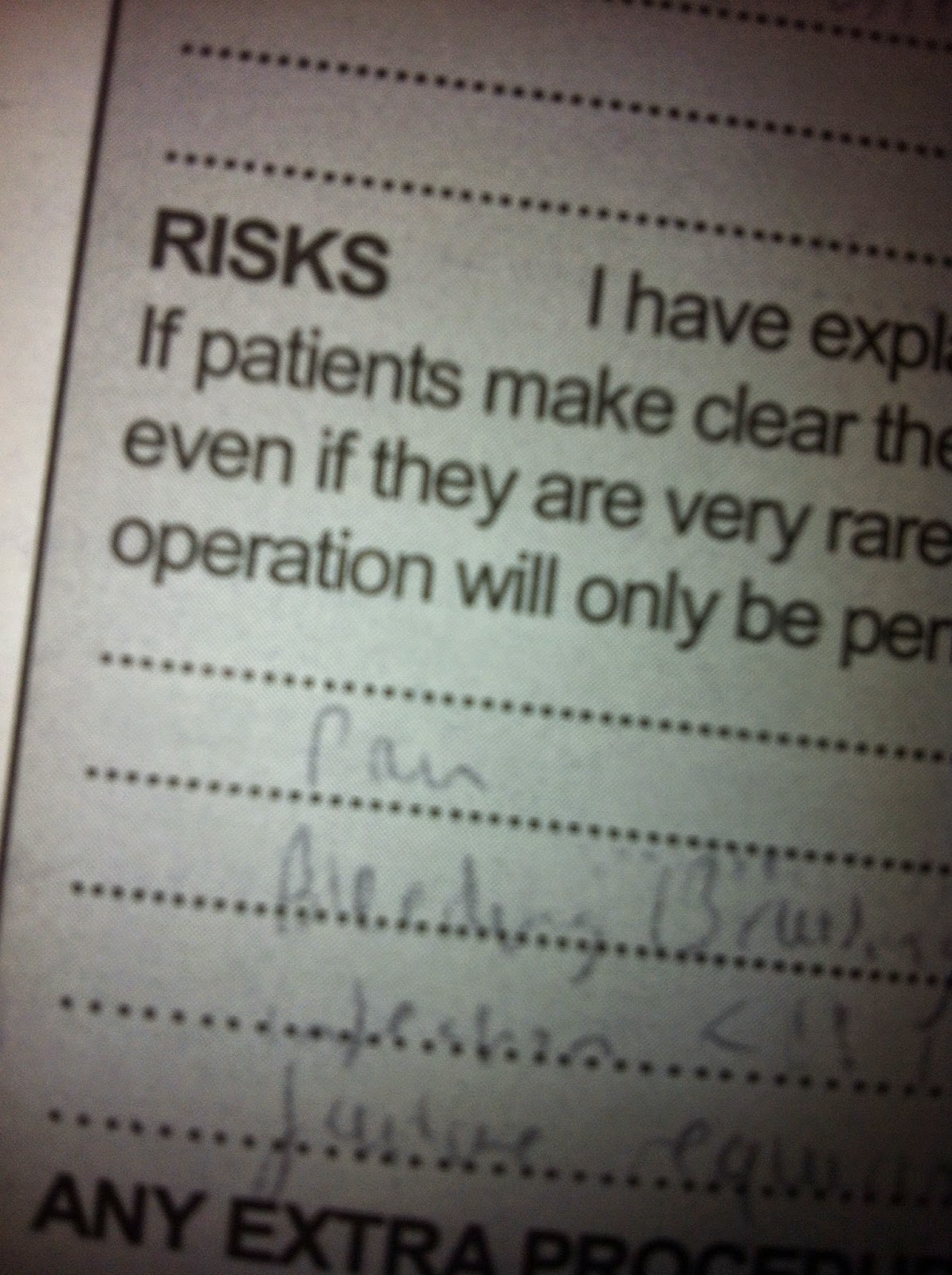
I go in the little room, with a doctor who is in the impossible position of trying to make small talk when we both know what is coming. She goes through the consent form. The main "risk" of BMB is pain. Risk? More like raging certainty. And she (always) makes sure to warn me that one risk is that it might be "unsuccessful" and need to be repeated. Oh joy. Then I sign the form, and lie on the bed, facing the wall, curled in a foetal position, with my trousers slightly lowered, waiting politely to be violated.

I've always had my biopsy in my sacrum, which is the triangular bone in your pelvis that attaches the hips to the spine. If you feel round from your hips towards your back, you'll feel two points of bone, just below the small you your back, either side of your spine. These are the corners of the sacrum. The doctor starts by feeling to find one of them, where she applies local anaesthetic, not just at the surface, but all the way down to the bone.

There are two parts of a bone marrow biopsy. First comes the "aspirate", which involves a needle right into the bone, from which about 5ml of liquid bone marrow is extracted. This is by far the most painful bit of the process, because one can feel the sensation all through the sacrum and down the leg too - like a sharp twang of sciatica.

Second is the "trephine" which involves a needle taking a sample of solid bone marrow. This uses an instrument with a cylindrical blade - it is driven into the solid marrow, twisted, and pulled out. This isn't so much painful as uncomfortable, because it means having one's bones directly pulled on.

Next, my favourite bit, is the moment when the doctor tells me that my solid sample isn't very good. Indeed, today, I can feel the trephine slipping as she extracts it, presumably because the site she is extracting it from is full of holes. There follows an entirely unwelcome conversation about myeloma bone disease, and the state of mine, and then the trephine process has to be repeated.

Then, once the bleeding has been stemmed, and a dressing applied, I am able to walk home, and wait for the anaesthetic to wear off.

And that's it. According to something I read recently, we're not very objective in our assessment of pain during an experience. We tend to perceive pain as the average of the most painful moment, and the pain at the last moment. And we tend to discount completely the length of time it went on for. As a result, we tend to perceive a very short experience of significant pain, as worse than a very drawn out experience, which may have long periods of high pain, but ends with pain gradually reducing. Part of the fear of BMB, I think, is due to this, because for a moment or two it really hurts, and then it's over. Ironically, if the doctors spent another half an hour inflicting minor pain, we'd probably view the whole experience so much more favourably. Knowing that little distortion of the mind helps me to grit my teeth through the process. Today's was a breeze. But then, I've had practice.

Friday, 15 March 2013

Perseverance

Your powa, inside. It rocks me like a lullaby.
Powa - Tune Yards

Day 8 : ... Haemoglobin 9.5 ... Neutrophils 0.03 ... Platelets 63 ...

It's not so easy to be lighthearted and witty about things when you feel grim. The docs ask me (very very frequently) for any pains and symptoms, but when I list the mix of abdominal cramps, nausea, lightheadedness and shivers that between them make up most of my experience, they just shrug. This is all, afterall, par for the course.

My temperature has been periodically spiking over the magic threshold of 38C - the point at which the medical system kicks in. So I have no end of tests. Blood culture tests. Another trip to x-ray, wearing a mask. Being required to poo in a cardboard dish. Swabs of all my intimate places. The doctor comes to see me, at 1am, and go through the endless questions, and then I am given intravenous antibiotics at 2am, so I don't get a great night's sleep.

Still, they really are very chirpy about me, and I think that really is because things could be a lot worse. Whatever happens, things could always be worse. We should all remember that when we're feeling sorry for ourselves.

Monday, 4 March 2013

Pipes

Knock three times on the ceiling if you want me. Twice on the pipe if the answer is no
Knock three times - Tony Orlando

No bed available today.

So I have to wait another day. I'm not frustrated - I know it just means some other soul is not quite ready to be discharged yet. Soon enough it may be me delaying others. Patience is something else I've learned a bit about lately. And I get another night in my own bed, with my wife. And another breakfast with my boys.

But I did go into hospital during the day and I'm delighted to be able to show you my new plumbing.

Think what you like.

At least you don't need to move the dishwasher, cut the worktop and demolish some cupboards to get access to it, which is more than can be said for our boiler.

Mind you, I didn't have to lie on my back for an hour with a plastic sheet sellotaped over my face when they fitted the boiler.

Swings and roundabouts.

Tuesday, 19 February 2013

Vertebroplasty

What I've got you've got to get it put it in you. Reeling with the feeling. Don't stop. Continue
Give it away - Red Hot Chili Peppers

No-one can really understand what myeloma is like unless they have it. But some of those near me now have a pretty good idea. Sorry about that - one piece of insight we could all do without. So here's an unmitigated good news story.

Since I broke my back I have become increasingly debilitated. It was at its worst when I was in the midst of treatment - full of tumours and chemicals. But even as things have calmed down considerably, I'm left with difficulty standing straight, pain if I stand up for any significant period of time and problems sleeping. I'm also still getting through quite a lot of painkillers (oxycodone these days, a synthetic opiate, and a controlled drug.) Much of this is due to the many fractured vertebrae in the middle section of my spine.

Tonight it feels like I've been released from one of my cages. I've had vertebroplasty on my spine today - acrylic cement to fill in some of the worst holes and (hopefully) alleviate some of the pain. It's done as key hole surgery. I spent only one night in hospital and was able to come home the same day as the operation. Amazing. I can't say how grateful I am for the awesome things modern medicine can do. And for the NHS, which does them all for me.

It struck me this morning quite how much I had invested in today. How down I would feel if nothing had changed tonight, or not enough. How I'd feel if I thought that it was never going to be better than this. But the good news is that, right now, I feel like I've got something back that I didn't know I'd get, and I can believe that I really can be fit and healthy again.

I read something online which suggested that the benefits of vertebraplasty might all just be a placebo effect. I don't think that's true, but even if it is, I'll settle for that.

Monday, 24 December 2012

Front line

When they kick out your front door, how you gonna come?
Guns of Brixton - The Clash

My "front line" therapy consisted of 5 months of chemotherapy. My myeloma was active, and I was getting increasingly ill. The drugs are powerful and knock you about a bit. And my head was spinning. Here's a flavour of the first two months.

August 2nd
A call with the myeloma nurse. I'm trying to work out which treatment programme to sign up for. Do I have the thalidomide based treatment on the NHS, followed up with a stem cell transplant? Or do I have the velcade/bortezomib based treatment in the PADIMAC trial? But if I do this and get a complete or very good partial response, they will want me to delay having a stem cell transplant.

There’s still so much I don’t understand. What’s “Very Good Partial Remission”? And what’s the prognosis if you get one? She can’t answer the second half of that. Because they don’t know (she doesn’t say that, she always finds sets of words about how difficult it is to generalize). What she does say is there’s plenty of evidence to lead most doctors in Europe to reckon front-line use of velcade is beneficial, and it’ll probably be licensed soon, and when it is, that’s what they’ll probably recommend for people like me.

And as for the stem cell transplant, I'm worried about signing up to a trial where I might not have one, when everyone seems to think they are the most important part of front line treatment. When I push her she confirms that were I to start the trial and then opt out, I’d not have lost any of my entitlements. I could then ask for an SCT. So the choice right now I reason, is about the velcade, not the transplant. And that’s much more straightforward. I’m beginning to realise that myeloma is full of “right now” decisions, only constrained by considerations of how one type of treatment might influence (preclude) other treatments later.
So PADIMAC it is!!

When can I start? She says either w/c 13 or w/c 20. I say that’s not precise enough – I need to plan my family’s summer. She eventually says she’s 70% confident we can start w/c 13th. I ask her why the 30%. This is basically because she hasn’t got me an appointment to have a PICC line catheter put in my arm, and I need that to have the treatment. So all we need now is to get the PICC booked in. But 70% will have to do – and so we book a week away at the end of the month, and for the older boys to go to Disneyland with my parents from 13th. The rest of our summer plans are in shreds.

I’ve received a few – very tasteful – mails from family, so I reply to them as a group. Thanks for your thoughts, here’s a bit more about myeloma, and here’s where I am today. I feel compelled to explain myeloma to people, otherwise they’ll just read all the awfulness online. The reality is pretty tough, but it isn’t as bleak and grim as all the “3-4 years” stuff one is presented with if one looks in unsympathetic places like Wikipedia.

August 3rd
Marisa tells me she’s decided she’s going to have a whole week off thinking about myeloma next week. In my heart I think this is a good thing – she’s been dwelling on it. But instead, rather unkindly, I say its all very well, but I can’t have “a week off”, and give the example of the need to cancel all our holiday travel plans. As it happens, I’d just had an email from one of the places we’re due to stay. Enough impetus to write a few depth-charge emails to cancel our bookings. While I’m at it I phone my course coordinator at university and let them know, and reach out to someone at church, so they know too. Then I feel I’ve told everyone I need to.

I feel bad about my response to Marisa. I’m worried she’s pogoing between despair and denial, and ultimately, needs to get to another place. We both do.

The nurse has promised to call me before she leaves for the day – and 2 weeks holiday – at 2pm, with a plan for my remaining tests so we can get started w/c 13th. At 2:15 I’m staring at my phone wondering whether to call her. Then she rings. She’s stayed late to try to sort one specific thing out for me. She has a plan worked out. I tell her I was staring at the phone.
“Alex, you can rely on me”, she says.
I start to cry and mumble back
“I know, I can”.
Only I don’t know, actually, because I’ve only met her twice, and there are so many other people I’ve met and I know I absolutely can’t rely on some of them. But I need to rely on someone, so I’m going to choose to rely on her. That’s a hell of a responsibility. I hope she really understands it. Of course, I don’t manage to say any of this, I just about manage to end the conversation in a dignified way and wish her well for her holiday.

August 4th
A day in town with friends, to watch Olympics on the big screens. All OK as long as I am very careful about how much walking, and take a chair so I can always sit down. Lovely friends, and a lovely day out. Not for the first time it's hard not to be resentful of strangers – swanning around like life’s easy; or, worse, standing on station platforms moaning about things that aren’t remotely big deals (when you know what a big deal really is).
“They didn’t have any in my size" So unfair!
“We only went to see the Beach Volleyball so we’ll never get to go to the Olympic Park" Shucks, you really missed out in life!
Even worse than that, being beastly to their children (this is a common one in Camberwell)
“Didn’t I tell you to shut up! [smack]”
It’s hard to know what to do with these feelings – after all the rest of the world hasn’t changed, only me. Why can’t some of these people have the serious issues to deal with? Why do the lives of my children – who get mostly loving parenting – have to be blighted? Fortunately, I guess, I don’t feel jealous or resentful of my friends, long may that last. But I don’t like angry and misanthropic feelings at all, and I hope they are a transient part of this experience.

August 6th
To the Olympics. A diversion (well needed). But first I have to negotiate the mobility transport to get in. The door keeper on the first leg gives me a highly suspicious look – I am after all a fit looking 6’4” male with no walking aid. On the other hand, I have a broken back and rampant bone pain, all of which gets worse with walking. I have to demand my rights – I do need transport, thank you very muchly. Fortunately, it gets easier after that, though being on a golf buggy full of oldies, beeping through the crowds, is an experience requiring a sense of humour, and every start and stop is really painful anyway, so it is only a partial solution to life’s problems.
On the way home the tube station is heaving. Rather than get on the first train, we head for the second, which is standing empty on the opposite platform, so I can get a seat. Once it has filled up and set off I find myself with a woman stood in front of me – probably in her 60s, but youngish for it, and dressed like someone from west London who wouldn’t normally take the tube. I can see her casting dirty looks at those of us in seats, and calling out to her husband something about
“... don’t realise how old I am!”
When the tube finally empties a bit, the couple sat down opposite us. She turns to him and says – clearly deliberately loudly for us to hear – that it was awful how some people hogged the seats. Marisa says to me
“Did you hear that, I’m really angry”,
and I reply – loud enough to be heard – something basically to the effect that she could
“f*** off”.
Not very elegant of me. What I wanted to have said (later, when I’d got my script in my head) was.

“(1) Please don’t take this as a compliment, because you don’t deserve one, but frankly you don’t look as though you need a seat. You should bear that in mind – you can’t always tell who needs a seat, just by looking. (2) These seats are reserved for those who need one, they aren’t an entitlement of age. (3) If you wanted a seat, you could have simply waited for the next train, which is what I did, because even if I sit all the way home I probably won’t be able to walk tomorrow, which I suspect isn’t a problem that will face you. And (4) if you really do need a seat, it would be more effective, and more polite, simply to say to someone, ‘Excuse me but I really need a seat, would it be possible if I could sit here’. That, after all, is what I would have to do, if I were in your position.”

I don’t know whether saying that would have helped. I understand that people don’t look at me and think ‘invalid’ – in fact I’m glad they don’t, but it's not nice feeling the need to continually justify oneself, either.

August 7th
Too much standing up and sitting down for national anthems yesterday? Feel like shit.
In to sign the PADIMAC consents. Yet more people! I know my nurse is on holiday, but I’d at least hoped to see the consultant. But we make do with what we’re given. I can’t help laugh when I'm told I’ll need to spend 24hrs peeing in a big bottle, and then she adds
“There are instructions, on the side of the bottle, how to do it”.
And I get quite frustrated when the registrar tells me – when I asked about infection risks and my family – that it would be best to avoid contact with children while I’m being treated. This just seems ignorant and insensitive. Even the suggestion to use it as a “good excuse” to avoid changing nappies fails to take account of quite how much burden is already falling on Marisa running around after me when I just need to sit, worrying about my diet, fending off callers, doing all the fetching and carrying I can’t.
They take me to visit the chemo ward. Like a tour of a new workplace
“There’s the coffee machine”.
The whole place looks like some ghastly hospice full of listless pale people on drips. Will that be me? Another bone marrow biopsy. Yet again they have to do it twice. The doctor says it is because my samples come up quite crumbly – i.e. the region of my sacrum is affected significantly by myeloma. This is glum news, which I mention gently to Marisa, but don’t share further. It suggests the bone damage extends from ribs and spine to pelvis. I know it’s visible in my skull too because the consultant showed me the pictures, but I’ve never had any pain up there (and hope I never do).

August 8th
Counselling. The counsellor is really nice, prepared to listen to me ramble on, and give me a chance to say things I daren’t say to anyone else. Of course, he couldn’t actually do anything. But I’ll go see him again. People suggest one might be reluctant to seek counselling, as though it might be a sign you were losing your mind. Frankly, given quite how much you have to deal with, I think you’d be mad not to at least try. It was nice to share a few unsharable thoughts.
The kids are being really hard work. Marisa says she doesn’t know how she’d cope on her own. And then we both say some unrepeatable things to each other. In the end I explain (clumsily) that if the worst happens, I won’t even be here to see how the “story” of our family plays out. I need the reassurance that they’d all cope and ultimately thrive, without me.

August 10th
Have decided today is the day to tell the children (not the baby, obviously). I have rehearsed another of my scripts!

“The doctors have been trying to work out why Daddy’s bones are so sore. They’ve found out that Daddy’s bones are ill deep inside. They are going to give Daddy medicine deep inside. This will mean Daddy has a tube fitted into his arm that goes right inside to his heart. It also means that Daddy might feel better some days, and worse on others. We all have to remember, at all times, not to jump on Daddy. And if we ever find any of Daddy’s medicine in the house, we must not eat it, we must give it to Daddy. And if we ever feel worried or have a question, or someone says something to us that we don’t like or understand we can always, always, come ask Daddy. Do we all understand? Are there any questions?”
“What colour will the tube be?”  asks Gyles.
“I don’t know, what colour would you like?”
“Gold”
“I’ll see what I can find at the hospital”.

It seems too cruel that they have to know any of this. And the sudden change in the way they hug me in the evenings is quite hard to deal with. They look nervous just coming near me.

Sadly, on the day, all the tubes are white.

August 11th
More emails, and cards and letters now the news has got out. I hope none of the emailers are really under any misapprehension that I’m going to be writing them regular updates, because I’m not. Some people write better than others. Some are easy to read. Some make you cry, in a nice way. Some make you cry in a slightly less nice way. One or two are actually slightly annoying to be honest. I guess one has to accept that everyone is simply trying to deal with it as best they can.

August 13th
PICC this morning. While doing all the consent blah they explain that if my veins were to spasm then sometimes it’s impossible to proceed, and best to try again another day. I explain my treatment starts tomorrow, so I’d rather not be in that situation. And then I lie there thinking “don’t spasm, don’t spasm”. Let’s face it I spasm frequently every day. But this morning, all is OK.

August 14th
Cycle 1 Day 1
After a last minute cock-up I end off having to start day 1 with a trip to Tommy’s for a PET scan. So suddenly I have a congested agenda, and have to bring Marisa (and Lyndon) as my taxi service. We start well, but then there’s some kind of delay and I lose my cool with the staff (the first time I’ve done so during all of this saga). This whole process is so awful and so frustrating and I just want to get on with it to get this horrible disease under control and get rid of the pain and not have my children’s summer completely obliterated. In the end it’s all OK. I write to them afterwards to apologise. They no doubt work really hard in a really stressful environment and get plenty of grumpy gits like me. Which they don’t deserve. And I wonder how many bother to apologise afterwards.
To my slight surprise Marisa is the embodiment of calm and composure – I thoughts she’d be worse than me, but she’s brilliant. Talking afterwards, I think she had her moment, but she got it together, which is what counts. The receptionist (whose husband has cancer – so this is a qualified comment) says you have to get used to this kind of situation. But I’m not sure she’s always right. If it was only me, I’d go with the flow – keeping my stress level down is actually an important element. But it’s not only me.

The first day’s treatment is fine but wow what a lot of pills. I have to find quite a big tin to keep them in (one of those dishwasher tablet refill tins is just about big enough) and write myself a detailed itinerary of what I have and why, and then a daily timetable to make sure I take them all as I should. The upside today is no immediate side affects at all.
They take my height and weight. I’m only 6’2”. So along with my summer, my health and all my dreams, this dreadful disease has already taken 2 inches off my height.
I get more supportive texts and mails today. The news is spreading among our friends. All very good messages and I’m glad to get them. Still makes you sad though, realising there are so many other people out there worrying. Some people communicate so beautifully, but sometimes we're simply being bombarded with too many messages. I know it’s well-meant, but it very irritating. We need to dictate how much myeloma dominates the conversation: Make a date to see a friend. Tell them in advance that it will be an occasion for talking about life as normal: the summer, the children. I think we have a right to choose when we do, and don’t, deal with myeloma, as far as we possibly can control it.

August 15th
Day 2
Treatment only takes an hour. How pleasant and efficient. I actually enjoy it. And the DEX appears to have solved most of my pain, so I’m skipping around like a new person. Let’s hope there are more days like today.
A headache this afternoon and then hiccups that felt they could turn, at any moment, into vomits. A bit anxious about whether, by tomorrow, I’ll be dealing with “side effects”.
Marisa has to go next door to collect a parcel that had been dropped off with our neighbour, who is in her 80s and very dear to us. I told her I was ill a couple of weeks ago – because I knew she’d care and because I knew she’d notice our comings and goings (and our lack of big summer holiday). But to be honest, we’ve been avoiding the conversation since then. Bound to ask if we see her, and we're not up to talking about it, right now. Tricky stuff. Who to talk to, when to talk. I guess it will get easier in time. At the moment, Marisa would prefer to talk to nobody. But that’s not possible. We are fortunate to have a few friends who are the absolute masters of discretion. Very valuable attributes indeed.

August 16th
I’m officially a DEXamanaic. full of steroids. Marisa says it’s impossible to get me to stop talking, and I’m in a constant frenzy of doing things. It reminds me of misspent moments of my youth. I fear what the comedown will feel like, at the weekend.

August 17th-23rd
The first week of my cycle finishes with a horrible down which I think is a combination of withdrawal from the steroids and side effects from my first bisphosphonate injection. It leaves me in a total heap – hardly able to get out of bed, shaky, miserable and in huge amounts of pain. I get a gentle ticking off at the hospital, for not having even bothered to check my temperature or referred to any of my paperwork to consider whether this is something that should trigger a call to the doctor. The experience certainly makes me take the whole process a bit more seriously.
The pain gets too bad and I have a complete change of pain management recommended – using morphine and a small amount of antidepressant to, between them, reduce the bone pain and overcome the muscle spasms.
By the second week of the cycle I’m really short of breath, which presumably reflects the 20% fall in my blood count, and is a direct consequence of the chemo. Even walking through the hospital is hard work.

August 24th-31st
The third week of the cycle involves no treatment, except steroid pills, so all that stops us leaving the clutches of the hospital is the need to change my PICC line dressing. Marisa bravely agrees to learn how to do it – first under supervision in hospital, and the following week “in the field”, while we stay at Center Parcs. I’m reduced to not much activity – dependent on mobility transport for much of the week, which is a mental challenge, if not a physical one. I’m also taking a lot of morphine. But I enjoy the escape – it’s a good week, and I feel my first cycle has been accomplished. I’d be lying if I said I wasn’t scared at the thought of going through this numerous times.

September 1st
My hair is falling out in great clumps. Strangely this (like the loss of height) matters to me more than I'd expected – just another thing the disease is taking away: my right to look healthy. A buzz cut is required. But even very short, my hair simply continues to come out. It won’t be long before it has to go completely – and this has to be accompanied by a conversation with the children that I could well do without.

September 3rd
Cycle 2 Day 1
I go into hospital to start my second cycle and there’s confusion all round. They have me down for tomorrow and though I point out that we’ve discussed for weeks why I want cycles that start on Mondays, I’m left unsure whether I’ll get treated. Eventually, it’s OK.
Then I stop in the pharmacy to pick up my painkillers on the way home only to discover the registrar has cancelled my prescription because she’s worried about my liver function. I’m left in a panic – even though I’ve been taking less painkillers in the last few days (they made me so groggy), I’m fully aware how out of control my pain was 2 weeks ago. Why can’t they talk to me as these decisions are made?
I take to the wine bottle tonight – in hindsight, a mistake. Gonna have to stop drinking.

September 4th
While sitting in the waiting area watching the Paralympics there’s an ad about Bowel Cancer. How much I hate the c-word, I just don’t want to hear about it. And the ad implies that late diagnosis of cancer is the patient’s fault for not getting checked out soon enough. How untrue some of us know that to be!
On the ward I meet another man in my own position – on PADIMAC, aged 40. It’s really comforting to see a real person.
I have a good day, but a bad evening – which I think is my own fault for being late taking my anti-emetic. Not a mistake I’ll repeat.

September 5th
Ben returns to school, and so I have to work out how to explain our circumstances to the staff. Myeloma involves a lot of explanations, but I’m frightened of what playground gossip might bring, and so the teachers need some understanding. It’s just one of many – this week I also write to my current university class, who I will see imminently, and to a range of previous university friends with whom I’m due for a reunion. People will know something’s up when they see me – bald and tea-total, so there’s no sense in which I can hide. My mother says the concerns about people feeling pity/sorry will only be shortlived, but I’m not sure that’s the point. It’s intense in the process and anyway it’s as much about the barrier, and the intrusion into my privacy and self-image that bothers me.
Before schools starts we have a meal-time conversation about illness, and I encourage the boys to ask questions. So we talk about PICC lines and pissing in bottles. It’s funny what they pick up on. I nervously introduce the c-word in to conversation – they may not need to hear it, but if they do they need to know its OK to repeat it in my presence. How I hate dumping this on such young minds. Why should they have to be aware of any of this?

September 6th
My liver function tests have been causing concern all week. Today the decision is taken – beyond my control, of course – that I should stop treatment for a week to allow it to recover. This frustrates me enormously, but the wonderful nurse talks me down. The aim is remission, and the drugs are a means. The doses are (frankly) best guess (those aren’t quite her words) and missing a treatment or two is not the end of the world. It’s a journey.
On the upside, I get my first cycle’s light-chain score. My numbers have halved. So something is working. The first piece of good news I’ve had since the whole charade started in July. I take the positivity home with me, and find some quiet work to do as I wait for the steroids to wear off, and the likely feeling of being weaker over the next few days than the last. My myeloma is, for the first time, retreating. Long may that continue.

September 7th & 8th
I have 2 whole days at university – which I was expecting to miss, but now I can attend. I’ve emailed my class to warn them, and actually its OK – a few questions, but nothing too hard to deal with. It’s extremely nice just to play at “normal” for the day. My back hurts pretty badly by the end though.

September 10th
My first break from steroids in a month. How nice to feel vaguely sober.

September 14th
Back into hospital for liver tests – will I have the last velcade shot of the cycle. Its apparent that this was highly unlikely anyway, and my results aren’t good enough. Frustrating again – not just that I can’t have treatment, but also at the waste of time – ½ a day in hospital for nothing.

September 15th & 16th
Manage a good walk in Sydenham Woods. I seem to be getting much more mobile. And then a half day at Lambeth Country Show. The limit for me is too much standing about – that really doesn’t do my back any good. Taking a chair with me helps – as long as I have domestic staff to carry it!

September 21st
I decide to keep a longstanding engagement and attend a college reunion (20 years since we matriculated). I’m feeling well enough after the week off, and I’ve either got many of these ahead of me (in which case why worry), or not (in which case why miss opportunities). Again, I’ve prepared the ground with a few warnings. Only one muppet comes up to me and (drunk and socially inept) starts a conversation by asking about my hair. In hindsight I could have let him off with a multiple choice answer
“Either (a) it’s just a meaningless haircut, or (b) it’s a statement of sexual identity, or (c) it’s a product of chemotherapy, or (d) it’s because I’m going bald. Next question!”
Instead I just reply “chemotherapy”, which leaves him suitably stumped. Tit. Actually, this incident reminds me how much better at these things most people are – and thank goodness for that. Staying up until midnight in the college bar stone cold sober is a novel experience.

September 24th
Another week off – this time because of low white blood cells. I find myself being taught how to self-inject G-CSF. A couple of months ago that would have been a real nightmare, now it’s just another little hurdle – yeah, whatever. I’m much more calm about the week off too – que sera, sera. The last 2 weeks have done me a lot of psychological good. I reckon it has taken me about 10 weeks to get my head round myeloma. Obviously, things are far from good but at least I have got some perspective, can think about things without descending to tears, and can be a bit more patient about treatment. I usually think I’m a pretty rational soul – I’m surprised this has taken me so long, really. Says something about what a big adjustment it is, I guess.

September 26th – 28th
I manage 3 days consecutively in university lectures. Feeling so much better. However, I also feel bone pain creeping back into my ribs and pelvis – which makes me worried what’s going on down there, while I’m not being treated.

October 1st
Cycle 3 Day 1
All blood tests normal, so back on the drugs. Hurrah, though I feel a bit pukey.

October - December
Once I am back on the treatment, I manage to complete 6 three week cycles. My light-chain scores had indeed gone back up during the break, and they fall back to around 50% of where they started, but then stubbornly stay there. During cycles 3 and 4 I feel pretty grim, increasingly suffering from abdominal pain and bone pain which I conclude is a side effect of the velcade. It's a bit like being repeatedly beaten up. Cycles 5 and 6 are a little less arduous, but I'm very very glad to stop, just in time for Christmas.
As the drugs wash out of my system, I'm feeling the best I have for many months.
Overall we've got my myeloma into what the doctors call "partial remission" - which appears good enough to stop me having too many symptoms, but is not enough to leave it alone, so I must begin the preparations for stem cell transplant.

So, that was my introduction to chemo. On the up-side, I don't think it will ever be this tough again - the emotional component must have exacerbated things, and it wasn't until several weeks in that I began to feel I was in control of myself. On the down-side, I'm almost certain to have to take some or all of these drugs, and others, in the future. I better just get used to handling the side effects.

Wednesday, 1 August 2012

Diagnosis

Warning lights are flashing down at quality control
Industrial disease - Dire Straits

Myeloma is very rare in people under the age of 40. One consequence is that doctors aren't looking for it, and it often isn't diagnosed until it has caused a lot of damage.  This is what that experience was like for me.

2008
It starts, somewhere, here. I'm on a bus with Gyles when the driver applies the brakes and I bang my chest on a seat rest. Something inside me pops. I have severe chest pain that won’t go away, way out of proportion to such a trivial knock. And it moves around - from one location to another. Even from one side of my body to the other. The doctor treats me like a hyperchondriac. I learn about the wonders of diclofenac - my first foray into what will become a long relationship with painkillers. After complaining to the doc that he isn't taking me seriously, I get referred for a chest x-ray. It shows nothing. I take this to mean there's no evidence of bone fractures (in fact, it wasn't the right kind of x-ray, but I didn't know that until much later).


2009-2011
So many dots I don’t join...
I have bouts of back pain, and intermittent chest problems – always with completely trivial “cause”s. For example: our car has an electrical fault and has taken to running its battery flat. With no power I can't release the boot to get at the jump leads. So I have several experiences reaching over the seats to get into the boot (and so putting my weight on my chest). Each time is agony, for days afterwards.
Increasingly I come to expect that any heavy lifting will cause me problems – even stuff that I know a fit man of my age should cope with: carrying boxes up stairs; getting the tent in/out of the loft; gardening. I harbour ambitions to buy land in the country, build a house, set up a hobby farm. But inside I wonder if I can really do this - I seem so frail. Many times I have to tell my children not to jump on me.
But the x-ray was clear. I am a fit healthy 36/7/8 year old. There's nothing wrong. I'm being feeble. So I do my best to ignore it all. But it won't go away. Am I imagining it? I wonder if I have some weird somatoform disorder - sensations of pain with no physical basis.

March 8th 2012
I get up really early to go for a run. Like 4am. This is because I’m in Stanford, California, teaching on a course. Night-time running when away on business is one of my secret pleasures. It means I can get a good 10km in before breakfast, keep my body clock a little more attuned to London time, and feel spectacular, and smug, all day.
I’ve been looking forward to this for weeks, England’s winter has been so cold, and my schedule so hectic, that I’ve hardly had a decent run since New Year. To be honest, this run is the best thing about the whole trip. The clocks in California are already on “Summer Time”, so at 4am it's dark. And this week there’s no moon. Where Campus Drive is unlit, it’s pitch black.
Towards the end of my run, I run off the edge of a kerb. It can only be 9 inches high, and I don’t fall over, but I come down with a real crunch. It already hasn’t been a good week for my back – a bit of inappropriate lifting, and a long flight. I know at once that I’ve upset things badly. The following morning I go out running again. I achieve another full circuit, but decide at the end that my back needs a rest. As it turns out, this is the last time I go running.

March-May
A lot happens in the next couple of months. Lyndon is born on April 16th and I begin a full time teaching placement two weeks later. Frankly, I haven’t got time for a bad back, so I ignore it. The pain is not getting much worse. I take a lot of ibuprofen. But slowly, the pain is increasing, and it’s different from previous back problems. In particular, there are weird muscle spasms all round my abdomen. My acupuncturist (a dear friend too) is amazed how stiff I am and says she’s not used to seeing muscle spasms like this. I have a couple of treatments with her, but I know this is really a job for a physio. When life calms down – I have one more overseas business trip to complete before June – then I’ll go to the doctor.

June 1st – 8th
We escape the jubilee (not my cup of tea at all) to a glorious Landmark Trust house in Dorset. Wolveton Gatehouse: spiral stairs, arrow-slit windows, oak beams and no TV. All week I realise I am really quite debilitated. The pain is getting worse, and after 3 months my back should, surely, be on the mend? Marisa tells me I must go to the doctor – she’s struggling with me not being any use for doing anything. I can’t even carry luggage up and down the spiral stairs.
On the way home we stop for lunch and I take the boys out in the beer garden to burn off energy. They play “It” around the picnic tables. I realise I simply can’t run – not even a couple of paces - due to the pain. I have to stand and watch while Grandad plays with them. He doesn’t mind, and they don’t notice. I feel terrible.

June 19th
I go to see the doctor (a different one, fortunately). She asks me the usual questions.
“Where does it hurt?” “Can you bend this way?” “Can you bend that way?”
I can’t give clear answers – it doesn’t really respond to bending, and it actually feels OK right now. And anyway, the pain moves about of its own volition. The most consistent (but not today) component is massive muscle spasms, which come from behind my shoulders all the way round to the front of my abdomen. In hindsight, I don't know why the fact that the pain was so difficult to pin down didn’t trigger any links in my mind at this stage to my recurring chest problems. Because they were always evasive like that too. (They still are.) She refers me to a physio, and gives me a load more diclofenac.

June 29th
The physio recommends a precautionary x-ray because it’s been 4 months since this flared up. He's sure its nothing – will just be mechanical. We plan some physio sessions anyway, starting next week.

July 3rd
During the back x-ray, I overhear the staff saying
“Does that look like compression?”
They do more x-rays. Someone asks me
“Have you been involved in an accident?”
When I say no I get to see the consultant. He says the report will be referred back and I should see someone in the next few days.
“Maybe an old injury is giving you some problems.”
I can do the two-and-two... I figure I’ve got vertebrae fractures. I begin for the first time to wonder if it’s the same problem as my chest. It can't be an old injury - my only possible “trauma” was in 1992 when I fell off the roof of NatWest Bank after a student party. But I went rowing the next morning after that. Even alcohol couldn't have acted as sufficient anaesthetic if I'd just broken my back! No, it must be new – must be the kerb in Stanford. I start googling “vertebrae fractures”. Have I got osteoporosis?

July 6th
Back to the physio. I have 3 vertebrae fractures T7, T8, T9 (actually, I have several more, we find out later). I can't have any physiotherapy until we’ve investigated. We discuss possible causes. He says
“It might just turn out to be left over from a drunken accident 20 years ago.”
He’s giving me optimism, I guess, and anyway, he doesn’t know. So I'm referred back to the doc. I’m worried, but only slightly more. 3 vertebrae sounds quite a lot, doesn't it. I google the vertebrae. The T- section stands for thoracic. These are the ones connected to ribs. T1-7 connect directly to ribs; T8-10 are aligned to floating ribs. Too much for a coincidence. My back and rib problems must be associated, I figure.

July 7th & 8th
Lots of googling. Could this really be a result of 20 year old trauma? Theoretically, it's possible, but I don’t believe it. I'm convinced that back and ribs are related, and that I have been breaking my ribs all these years (subsequent tests show up several rib fractures). If so the superficial causes of my injuries are as trivial and meaningless as a braking bus and a 9 inch kerb. Do I have osteoporosis? Or a similar condition? I decide it must be one of these. It can’t be anything worse, because everything worse is terrifying. Cancer? Necrotic infections? I google all the weird necrotic conditions. They’re all hideous, and frankly none of them sound any better.

Except they’re not  C  A  N  C  E  R.

To be honest, I can see that my symptoms don’t match any of them, expect myeloma, but I manage to hide that from myself. Marisa thinks I’ve got cancer. I tell her I haven’t, I’ve got osteoporosis.

July 9th
I go to see the doc. He says
"We need to take a broad approach” to find the cause.
So he orders a range of blood tests and a bone scan (what’s that?!) He doesn’t exactly ooze bedside manner. Professional and friendly – but I’m beginning to be worried, and he doesn’t do much to allay or manage my worry.

July 11th
Blood tests. I hate needles! (I get over this hang up pretty quickly, once I become a regular in the haematology dept. I still hate them, really, but I have bigger things to worry about, these days.)

July 12th
I have a bone scan. I’ve looked this up. It's nuclear medicine and measures bone metabolism. I notice this isn’t a DEXA scan, which would measure bone density. DEXA would be a good test for osteoporosis, whereas a bone scan will show up more ominous symptoms. It suggests the doctor is thinking of different things from what I'm still clinging on to. Ever the optimist, I managed to avoid getting myself too concerned.

July 13th
I get a letter from the surgery. My blood test results are back, and I should make a telephone appointment. Presumably that's a good sign, right? I arrange one for July 18th.

July 17th
I’m working in the study when the doctor calls. She says
“Holes in bones”. "Lytic lesions". “Might be myeloma”.
I should come in for a face-to-face appointment urgently.
“Sorry this probably comes as a horrible shock”.
I start frantically googling. Holes? Hotspots? Cold spots? What do bone scans detect, exactly? Pretty likely this is bad shit.
You can simulate this experience if you like. Type "lytic lesion" into google, and see where it takes you.
I cry. A lot. Mostly into my PC. I google, too much, telling myself to stop.
After about an hour I pick myself up, walk downstairs and relay everything to Marisa  – one of the most painful things I have ever had to do in my life. Lots of crying and holding each other. Mostly crying and holding each other, really, what else can we do? But we have a house full of children, so have to pull ourselves together to face them.
In the evening I try to call my Mum. She’s out. Probably a good thing. Later, I go out for beer with one of my oldest friends. It's the first time I talk to a friend about any of this. He is typically optimistic. Is this because he’s being nice, or because he doesn’t understand how serious this all is? (A bit of both, probably.)

July 18th
I see the doctor again. He thinks this is myeloma, I can tell from his attitude. I ask about the “holes”. He shows me the report. It uses the words “widespread lytic lesions”. He says we need to do more tests – he’s going to set up 3 blood tests and then call the haematologist at King's. He tells me myeloma is treatable, which isn’t remotely reassuring because I’ve already read that it's incurable, and seen life expectancy figures which are frankly terrifying.
He says the results might take a week. Why? If I’ve got myeloma – and I think I have – then I want a referral to a specialist. It’s quite obvious the doctor is at the boundary of his own expertise. But he knows a bit about the tests – he thinks there’s a new one which can be done from blood but used to be done from urine, and the blood one is better. He looks it up. At the latest when all the results are in, he’ll call me on Wednesday 25th. I'm not sure I can wait that long, any more.
I go straight down the hospital to do the blood tests, googling them on the way in the car.
1) "Creatinine" – kidney function – kidney damage is another likely consequence of undiagnosed myeloma
2) “Serum protein electrophoresis” – finds spikes of proteins – i.e paraproteins. Good for spotting cancers. Myeloma typically produces an “M-spike”
3) “Serum-free light chain analysis” – specifically finds myeloma paraproteins. Relatively new test. Previously needed a urine test but this only detected levels above a threshold when the kidneys couldn’t cope.
I come home and google “widespread lytic lesions”. It’s either (a) myeloma or (b) so weird and unusual that people write research papers about individual cases of people who manage to have this level of bone damage without myeloma. So, we’re only looking for 1 thing now. This is no longer “broad”.
I'm going have to tell my family. We’re off to Legoland on Saturday and (a) they’ll ask about my back, (b) I won’t be able to go on the rides (and I’m a famous lover of rides), and (c) I’m limping and not sure how far I can walk without stopping to rest. So I write a script. I have a text message conversation with Mum. Dad’s away tonight. I don't want to drop this on her alone. So we have a chat, but I don’t touch the script. That will have to wait another day.

July 19th
Realising that my brother Matt is not always easy to catch by telephone, I figure I better try him today, too.
First, I go to a the management meeting at the local Community Centre, where I've just joined the committee. I'm not really interested in any of the agenda, or much fun to be around. I can only think about one thing. We keep discussing jobs that need doing. Could I do them? I say no without offering a reason. It all feels really uncomfortable. The meeting runs late. I want to make my phone call. Eventually I excuse myself. I try to call Matt, but he’s out. So I leave a message with the babysitter that I need to talk with him before the weekend.

July 20th
I phone my parents at 9am. Dad answers the phone, thereby drawing the short straw. I try to gently explain the situation without too much alarm. I just about keep it together. I tell them the chronology, and about the lesions, omitting the words “widespread lytic” to make it harder for them to scare themselves to bits on google. I tell them it could be benign, but it could be worse, and that I’m awaiting test results. In the end I don’t mention “myeloma” – what’s the point? I had carefully written it into my script, but I can’t bring myself to go that far, in the end.
And then Matt calls. So even though he’s standing in the corridor at work, I go through it again with him. I have no idea how he dealt with that.
What a truly horrible experience. Knowing I’m going to be the cause of sadness in other people is the hardest thing to deal with.
I go out for lunch with another old friend and decide not to tell him anything. It’s liberating and I have a lovely couple of hours. Even the awkward points – summer holiday plans, emigration to NZ plans – I manage to pass off by replying as I would have done 2 weeks ago. I don’t even feel like I’m deceiving myself much.
At 4pm I get curious and phone the doctors. The receptionist lets slip that 2 of my results are in and they’re both normal. I demand that a doctor calls me back, which she does. My kidney function is normal, and there’s no M-spike. A couple of my protein levels are a bit low – but she doesn’t know what this means. She says we can’t really draw any conclusions until we have all 3 results. I explain to her that a bit of good news is nice, even if it’s transient. She offers to call again on Monday. I say I thought they’d call me as soon as the light-chain result was in. She says all that had been put on put on the file so far was to call me on the 25th. The thought that I’d have been made to wait for all of this information until next Wednesday is horrible, and I get quite upset with her about the overall level of patient care. But the doctor on the phone is nice, and promises to call on Monday. She also offers to be my only point of call from now on, and tells me from now on to call reception and insist on getting a call from her, or an appointment with her, even if they try to fob me off. When I've subsequently had to take her up on this advice, you certainly feel like you are digging your heels in. Why are doctors’ receptionists so rude? But the process does work. And having some stable points of contact is invaluable.
I phone my parents again, and then Matt, to share the love and the glimpses of good news. At this point – because it’s necessary to explain what we do and don’t know – I mention the word myeloma.

July 21st
Legoland. Actually, it’s better than it could be. I feel OK. I can walk. The children don’t really notice quite how many rides I miss – and there’s always the excuse of the baby to look after. My parents don’t mother me too oppressively, there’s a few more questions but its all OK. I see both my Dad and my sister-in-law Fi taking time to talk with Marisa. I’m increasingly worried about her, so that’s good. The strain on her is as bad as the strain on me.
Another old friend comes to stay tonight. I tell Marisa we’re operating a “don’t talk about it” rule for the evening. She's been bottling it up until now but has recently found it helpful to talk to people about it - a lot. We're living it 24/7, and I'm struggling with that. As we'll both learn, again and again, having differing rhythms in our coping mechanisms is yet another of the challenges we face. Late in the evening, I can’t help open out the sofa bed. He asks why and so I tell him. Oh to be the bringer of good news.

July 22nd
I feel absolutely awful today. I am 100% certain it must be myeloma, M-spike or no (I might have a bit of a hangover too, but I can tell the difference). There is aching all over my back, ribs and pelvis. Ineffectively I try to hide it from Marisa. She’s still full of the good news from 2 days ago. This is the first time I’ve seen her so optimistic, I can’t bear to burst the bubble.
My friend is playing in the garden with the boys. Relay race practice (Olympics inspired!) and then football. I decline to join the running at all, and do a pretty lame effort of joining in the football. I feel like an failure who can’t fulfil my functions as a Dad.

July 23rd
The doctor calls. My light-chain results are abnormally high. She wants to submit a form to the haematologists at King's (At last!). It’s a “14-day-response” meaning they must see me in 14 days, but she’s sure it’ll be quicker, indeed that this will really begin to accelerate things. 14 days!! I don’t think I could bear it. She’s spoken to the haematologist since we last spoke and so got a bit more understanding. She thinks they’ll want to do a bone marrow biopsy and maybe more scans. I google “bone marrow biopsy”, it doesn’t sound much fun.

July 24th
The haematology department calls. Thank goodness it didn’t take 14 days. An appointment for tomorrow.
“Will that be for both scan and biopsy?” I ask.
No, just to see the consultant. Not a bad thing – I’ve been wanting to see the consultant for what seems like ages.

July 25th
I go in to King's alone. Marisa and I have a coffee together first at Love Walk Cafe. We’re both apprehensive, but also being practical. Maybe today I’m only 95% certain, and she’s probably more optimistic than that. But any which way, I feel we’re beginning to get ready for what’s coming.
The haematology waiting room is full of ill looking old people. And many of them seem to be regulars – I realise for the first time that I’m probably going to be a regular too. And I’m probably going to look ill. And there’s some question about whether I’ll ever be old.
The initial consultation is a bit confusing – there’re 3 people in the room plus me and I don’t know who they are, except my consultant, who I’ve looked up. He tells me he thinks I have myeloma. He tells me we can only make a definitive diagnosis on the basis of symptoms, plus protein scores, plus biopsy. So I need to have a biopsy to get a diagnosis. I ask
“If it isn’t myeloma, what could it be?”
He says
“I think it’s myeloma.”
So that's that, then. I ask a few more badly constructed questions. I’m not sure what answers I’m looking for. And I can’t remember any of his replies! Then one of the nurses takes over. This conversation takes place inside the haematology treatment centre which is intimidating – comfy hospital chairs, partition curtains, drips, machines and so on. She’s a myeloma specialist care nurse, which is simultaneously reassuring and utterly damning. I'm doomed. This is real. Her badge also says “MacMillan” on it, which is somehow very hard to accept, because it puts me in the general category of cancer sufferers, which I haven’t really thought about yet. She helps explain a lot, though again I struggle to take much in. She asks me outright if I’ve googled myeloma.
“Enough to scare the shit out of myself” I say.
I can’t keep back the tears now. She tells me that it’s normal to google, and hard to deal with that, and it will take time to comprehend. I tell her about the boys – somehow I feel like it's all particularly unfair because I have such young children. She tells me there are others like me. She’s nice and I believe her. But it doesn’t make it any better.
I walk home writing a mental script and then slowly talk this all through with Marisa. She deals with it better this time. I can see her reaction is like mine – we’re both in denial and doing a bit of bargaining, if you know your Kubler-Ross.

July 26th
Bone marrow biopsy. Wow that hurts.

July 27th
The older boys have been at my parents for the week. I’ve suggested they bring them home this evening – quite late because they need to avoid the Olympic Opening Ceremony traffic. I’ve written another script and we go through it slowly. Dad is immediately in compassionate and practical modes
“If I could swap blood and bones with you...” “Whatever we can do...”
Mum just sits there. She’s not known for being quiet. Her eyes are red but she doesn’t really cry. I know this must be tough for her – especially as she’s still dealing with my Granny’s slow recovery from a stroke, and my aunt's chemotherapy for peritoneal cancer. But I’m beginning to accept that I am not responsible for other people’s sadness, and I’ve got a lot of things to worry about myself.
I agree that my parents will talk to the rest of the family – I don’t want that responsibility. On the condition that I do not want “Get Well Soon” cards. And somehow, it still matters a lot to me for them to make clear to anyone that it hasn’t actually been diagnosed yet, it just looks very likely. (In hindsight, I have no idea why this mattered at the time. Had there been a miracle, was I worried I'd end off looking foolish? But if there had been a miracle, would I really have cared about looking foolish?)

July 28th
I bump into some cousins in the park. Small-talk. Marisa & I are both standing there haunted by the unspoken subject, more potently because one of my cousins has slipped a disc and is on crutches. Shall I drop the bomb? On the spot I make the decision that it's better to have the confidence to tell people (those who I want to know). These are my family, they will find out soon enough and I wouldn’t want them to think I was ashamed/embarrassed/scared. My cousin is a nurse and her husband is a doctor and both Marisa and I observe the looks they can't hide on their faces when they hear the word “myeloma”. We'll come to learn a lot about how to cope with other people's reactions - in their many and unpredictable forms.

It get's me thinking about the process of telling people. I don't have the strength to set out to tell everyone in my life. The mums at the school gate can all learn by grapevine as far as I care. And gossip about it. And if any of them come up to me with a badly-considered comment, I reserve the right to say what I feel. And if they do the same to Marisa, I reserve the right to... well, whatever happens.

July 29th
We're out for the day visiting friends, who know where we're at. These are the kinds of friends we are lucky to have. Ones who will be sensitive, and stick around with us. I think Marisa finds the occasion harder than me, because it involves yet more talking about it. I struggle only with the well meant advice.
“Lying down is good.”
“Yes, but when I lie down and then try to sit up I’m immediately in so much pain.”
No-one else knows what it's like, and frankly, right now I'm quite sure I wouldn't want them to.

I know the weeks ahead will bring all sorts of uninvited, but well intentioned advice of the “my grandpa once had xxx...” variety, and that won’t help me at all.

What I find difficult is having to resort to sitting in a comfy chair for half the day. I feel like an invalid.

A text message has been haunting me for the last 2 days.
“What was the result of the tests?” I pluck up the courage to reply
“Not good, unfortunately. Been having lots more tests. I’ll get a formal diagnosis this week. But realistically I already know what it will be. Think they’ll give me a treatment plan this week too.”
“Oh shit :-(“
And then, nothing. He's probably got no idea what to say next.

July 30th & 31st
Somewhere in the week Marisa has a complete disintegration on me and tells me
“I wish I was dead.”
I snap back
“You wouldn’t say that if you thought you soon might be.”
How I regret saying that. She is dealing with all the same issues I am. On the other hand, I’m simply not going to be strong enough to carry her through this.
Twice recently she’s told me through gritted teeth that “We’re going to fight this”. I know why she’s saying it – she doesn’t want me to fade away. But at the same time I find it quite hard to hear. How am I supposed to fight this? It’s not a “Get up and walk!” situation. It's happening deep inside me, in my plasma. If only it were a tumour in an organ, I'd have something to focus my energy on. We could cut it out! But it's not like that at all. Obviously, I’m going to do what the doctors tell me. I’m not about to start emulating some of the deranged ideas I've read in other people's blogs, where they quit their chemo and try herbal remedies, and are then surprised when they relapse.

But the only way I can “fight” it myself is through belief – not letting it destroy my life, my outlook, my view of the world and of others. To the extent that my mind can contribute to my treatment, that’s the best I can offer. I guess that's my synopsis of the story of Jesus Christ. You can’t make the world a nice place. You can’t guarantee your own destiny – no matter how rich or powerful you are. All you can do is be a positive influence. Love others. Look for the good. That's my faith. I'm going to have to see if I can live up to it.

More prosaically, I’m beginning to get a bit of succour from fellow travellers. I’ve discovered Myeloma UK, and the helpful reassuring forums there. And I’ve discovered an “Under 50s” group and a few kindred souls. From now on, when I’m online, I’ll spend more time there – better information, from more sympathetic sources.

August 1st
D-day. Diagnosis. Marisa comes with me. In some ways that’s wonderful – support for me, and also I think it will help her come to terms with this. In others, it’s awful – she’s making all the same assessments of the waiting room that I was last week. Marisa points out afterwards that
“he still didn’t say it’s definitely myeloma”.
But he did. He just said it gently. Denial is a perfectly normal response: don’t hear what you don’t want to.
I’m presented with yet more people – from the clinical trials team this time – and come away with 2 packs of information on the NHS prescribed therapy "CTD", or a clinical trial "PADIMAC". They’re not recommending the trial to me, because they're not allowed to. So in fact they aren’t really steering me one way or the other. I'll have to decide for myself whether I'd rather take thalidomide (yes, you've heard of it, huh?) or bortezomib (which you haven't heard of, and nor have I). That's a big decision to put in the hands of someone who last studied biology when they were 12 years old. I spend the evening researching loads of complex drugs, clinical trials, types of stem cell transplant and so on. It’s crazy – I’m expected to make the choice, and I’m no medic. But then every dimension of myeloma is crazy.

Crazy dimensions of shit.

Since diagnosis I've had plenty of time to reflect, and I've retained both my sanity and my sense of humour. But it has not been without its dark moments. I don't think any of this can be made any easier for anyone involved. It's just something you have to go through. If you are going through it too, know at least that you are not alone.